


If you’re wondering how to sue for a cutting injury at work, you will need evidence showing that your employer’s negligent actions caused you harm. Employers must take reasonable steps to ensure staff safety at work, such as supplying cut-resistant personal protective equipment (PPE), providing role-specific training, and maintaining machinery guards. If your employer failed to meet their legal obligations and you suffered a cutting injury as a result, you may have grounds to make an accident at work claim.
Our panel of expert solicitors can help gather evidence on your behalf, including training records or maintenance logs showing an employer’s failure to properly service machinery. At How To Sue, we understand that the process of starting a claim against your employer can be daunting. That’s why our advisors are committed to giving you the information you need. They are available 24 hours a day, 7 days a week to answer your questions and provide tailored advice.
Following a free initial consultation, you may be connected with one of the specialist No Win No Fee solicitors from our panel. With decades of combined experience in accident at work claims, our panel have extensive experience guiding injured workers through the legal process, and is ready to support you next.
To learn more about how to sue for a cutting injury at work, please contact our advisory team today.
We are here to help you
Here at How To Sue, our expert advisors are on hand 24 hours a day 7 days a week to assess your compensation claim. Should you require free legal advice we can connect you to a specialist solicitor.
Frequently Asked Questions
- How To Sue For A Cutting Injury At Work
- What Are Examples Of Workplace Cutting Injuries?
- What Are The Complications Of A Cutting Injury At Work?
- How Much Workplace Cutting Injury Compensation Can I Sue For?
- What Will I Need To Sue My Workplace For Cutting Injuries?
- Why Choose Our Panel Of Solicitors For A Cutting Injury At Work Claim?
- Can I Sue For Workplace Cutting Injuries On A No Win No Fee Basis?
- Learn More
How To Sue For A Cutting Injury At Work
To sue for a cutting injury at work, you must be able to demonstrate that your employer’s negligent actions directly caused you harm.
Under the Health and Safety at Work etc. Act 1974, employers owe a duty of care to their employees. This means they have a legal obligation to take reasonable steps to protect the health, safety, and wellbeing of their employees. For employers, this duty can include installing safety guards on machinery, properly maintaining sharp tools, and providing cut-resistant gloves or other role-specific personal protective equipment (PPE).
If your employer fails to take such steps, causing you harm, this may amount to negligence. To have a valid claim, you must fulfil the following eligibility requirements:
- You were owed a duty of care by your employer.
- Your employer breached this duty of care.
- You suffered cutting injuries as a result of that breach.
To learn more about the eligibility criteria for claiming, please get in touch with one of our friendly advisors today.
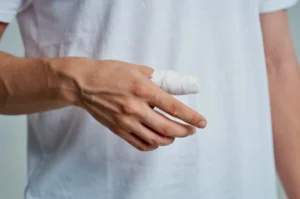
What Are Examples Of Workplace Cutting Injuries?
Common causes of workplace cutting injuries include contact with sharp objects, power tools, or defective machinery. Below, we outline some scenarios showing how an accident at work claim might arise as a result:
- Your employer fails to replace or repair broken safety guards on factory machinery. The lack of protection results in your hand being severely cut, leaving you with a deep wound and permanent nerve damage.
- While working as a binman, you suffer a needlestick injury because your employer neglects to provide adequate, puncture-resistant gloves. The incident causes you considerable emotional distress due to the risk of blood-borne infection.
- Warehouse management ignores multiple staff reports about hazardous debris in a walkway. Due to this failure and a lack of protective footwear, you suffer deep punctures and lasting scarring after walking over shards of glass.
- Despite not receiving any relevant training, your employer instructs you to work with industrial blades. This lack of training leads to a severe laceration that permanently reduces grip strength in your hand.
If you have questions about claiming for workplace cutting injuries in your specific circumstances, please get in touch with our friendly advisory team today.
What Are The Complications Of A Cutting Injury At Work?
The complications of a cutting injury at work can range from immediate nerve damage to permanent cosmetic scarring and chronic conditions. Depending on the location and depth of the injury, there may be:
- Deep tissue damage to muscles, tendons, nerves, and arteries.
- Traumatic partial or full amputation of fingers, hands, or toes.
- Embedded foreign objects from flying debris or projectiles.
- Severe haemorrhage resulting from deep arterial cuts.
- Wound infections caused by contaminated or poorly maintained tools, potentially leading to swelling, abscesses, or life-threatening sepsis.
- Tetanus from contaminated deep puncture wounds.
- Permanent loss of sensation or persistent pins and needles.
- Psychological trauma, such as post-traumatic stress disorder (PTSD), depression, or anxiety.
To learn more about how to sue for a cutting injury at work, please get in touch with our team today.

How Much Workplace Cutting Injury Compensation Can I Sue For?
The amount of workplace cutting injury compensation you can sue for will depend on a range of factors, including the depth and severity of your injuries, the cosmetic impact, and whether you have incurred financial losses.
If your cutting injury claim is successful, you will be awarded with general damages for your physical and mental pain and suffering. This head of claim is typically assessed by a solicitor using a copy of the Judicial College Guidelines (JCG), as the document contains a range of suggested compensation brackets for various forms of physical and psychological trauma.
All entries in the table below, apart from the first figure, have been taken from the JCG. Please be aware that these are merely guidelines and do not guarantee how much you might be awarded.
| Injury | Severity | Compensation |
|---|---|---|
| Multiple severe injuries with financial losses | Severe - with special damages such as lost earnings, laser surgery to reduce scarring, and therapy costs. | Up to £1,000,000+ |
| Facial scarring | Very severe - with a disfiguring cosmetic effect. | £39,340 to £128,590 |
| Facial scarring | Less severe - where the figure is substantial with a psychological reaction. | £23,730 to £63,970 |
| Facial scarring | Significant - where the worst effects will be reduced by plastic surgery. | £12,040 to £39,750 |
| Facial scarring | Less significant scarring - may be a single scar or several that are very small, with marring effect without marked impact on appearance. | £5,220 to £18,150 |
| A Number of noticeable laceration scars or single scar that is disfiguring | Typically of the leg, arm, hands, back, or chest. | £10,350 to £30,030 |
| Damage to the digestive system | Severe (i) - with ongoing pain and discomfort. | £56,820 to £81,790 |
| Damage to the digestive system | Serious (ii) - causing long-standing complications. | £22,180 to £36,680 |
| Damage to the digestive system | (iii) - including cases involving industrial lacerations. | £8,730 to £16,640 |
Can I Sue For Special Damages After A Cut Injury At Work?
Yes, you can sue for special damages after a cut injury at work if the harm you suffered resulted in monetary losses. This head of claim can cover the cost of:
- Lost earnings, including bonuses, overtime pay, promotions, and future reductions in income, particularly if permanent issues with dexterity or grip strength affect your ability to work.
- Medical expenses for prescriptions, private consultations with reconstructive surgeons, or laser therapy to reduce scarring.
- Travel, such as fuel or public transport fares, for journeys to and from medical appointments.
- Rehabilitative support from specialist occupational therapists or counsellors.
- Care provided by a professional or loved ones if cuts to your hands or arms leave you unable to dress, cook, or carry out other everyday tasks.
Special damages must be supported with evidence, typically payslips, invoices, receipts, and bank statements. Our panel of solicitors can help you document these losses, ensuring your claim accurately reflects the financial impact on you.
To discover more about the factors which may influence compensation for lacerations or other cutting injuries, please contact our advisory team today.
We are here to help you
Here at How To Sue, our expert advisors are on hand 24 hours a day 7 days a week to assess your compensation claim. Should you require free legal advice we can connect you to a specialist solicitor.
What Will I Need To Sue My Workplace For Cutting Injuries?
To sue your workplace for cutting injuries, you will need to prove your employer’s negligence whilst also complying with the relevant time limit. We outline both of these steps below and show what you can do to strengthen your legal position.
How Can I Prove Workplace Negligence Led To My Cut Injury?
You can prove that workplace negligence led to your cut injury by providing evidence of unsafe working conditions, such as a copy of the entry in the company accident book. In addition, you may also be able to photograph visible machinery defects, obtain maintenance logs for blades and other sharp tools, or request training records showing you were not properly instructed on how to use cutting equipment.
There are many other documents that can strengthen your claim. If you are connected with a solicitor from our panel, they will take a hands-on role in helping you gather this proof.
How Long After A Cut Injury At Work Can I Sue For Compensation?
You generally have 3 years after a cut injury at work to sue for compensation. This period begins on the date of the accident, as per the Limitation Act 1980. However, there are some exceptions, as our guide on the limitation period explains in detail.
For a more tailored discussion of the workplace claims process or how the time limit might apply to your situation, please feel free to get in touch with our advisory team today.

Why Choose Our Panel Of Solicitors For A Cutting Injury At Work Claim?
You should choose our panel of solicitors for a cutting injury at work claim due to their dedicated support from start to finish. Our panel of solicitors don’t just provide legal representation, but they put your recovery first and handle all the communication with third parties. If you’re connected with our panel, you will benefit from:
- An independent medical assessment by a medical expert who will thoroughly evaluate the impact of any permanent nerve or tendon damage, movement restriction, and long-term psychological trauma.
- Regular updates about the status of your cutting injury claim so you’re never left wondering where it stands.
- Assistance with gathering evidence relevant to your case, such as maintenance or training records that can highlight contributing factors that led to you suffering lacerations or deep tendon cuts at work.
- Expert legal insight about the legislation applicable to cutting injuries at work, ensuring details like an employer’s failure to supply cut-resistant gloves or other job-specific PPE do not get overlooked.
- Connections with surgeons and occupational therapists specialising in complex injuries involving cuts to tendons, ligaments, and muscles.
Can I Sue For Workplace Cutting Injuries On A No Win No Fee Basis?
You could sue for workplace cutting injuries under a No Win No Fee agreement if you’re connected to one of the specialist solicitors from our panel. Using a Conditional Fee Agreement (CFA), you could experience:
- No solicitor service fees at the start of your case, as it progresses, or in the event that it’s unsuccessful.
- If your cutting injury at work claim is successful, you will pay a success fee to your solicitor. Please be aware that this fee is capped by law and will be taken from your compensation.
Contact How To Sue For A Cutting Injury At Work Claim
To discover more about how to sue for a cutting injury at work, please feel free to contact our team:
- Call us on 0800 408 7827
- Contact us online by completing our form
- Use our free live chat feature

Learn More
For more information on personal injury cases, please view our helpful guides:
- Learn how to sue for a hand injury at work
- See the following advice about how to sue after tripping over wires
- Get help with claiming for a fatal accident
Additional external resources:
- Learn how to treat cuts and grazes from the NHS
- See the following advice on the inspection of work equipment from HSE
- Get help with statutory leave and time off work from Gov.UK
Thank you for reading our helpful guide about how to sue for a cutting injury at work.